Bud Rot in Grow Rooms: Why Humidity Control Matters More Than Treatment
Updated: Jan. 13 ,2026 · 4 min read
Abstract: Bud rot is one of the most damaging issues in indoor grow rooms, often appearing late and causing irreversible losses. While many focus on treatment, the real cause is usually environmental instability — especially uncontrolled humidity, poor airflow, and inadequate moisture management. This article explains how bud rot develops under high-moisture conditions, why temperature control alone is not enough, and how proper grow room HVAC design with integrated dehumidification, balanced airflow, and dew point control can significantly reduce the risk. In controlled environments, prevention starts with the system, not the plant.
Table of Contents
show
Bud rot is one of the most frustrating and costly problems in indoor cultivation. It often appears late in the cycle, when plants look healthy on the outside but the flowers begin to decay from the inside. By the time it becomes visible, the damage is usually irreversible.
Most growers’ first reaction is to look for a treatment. But in reality, bud rot is rarely a plant-level problem. It is almost always a climate control problem.
Unstable humidity, poor air movement, and HVAC systems designed for comfort cooling — not moisture-heavy grow rooms — create the exact conditions bud rot needs to develop.
If the environment is not controlled correctly, bud rot is not an accident. It is a system outcome.
What Is Bud Rot?
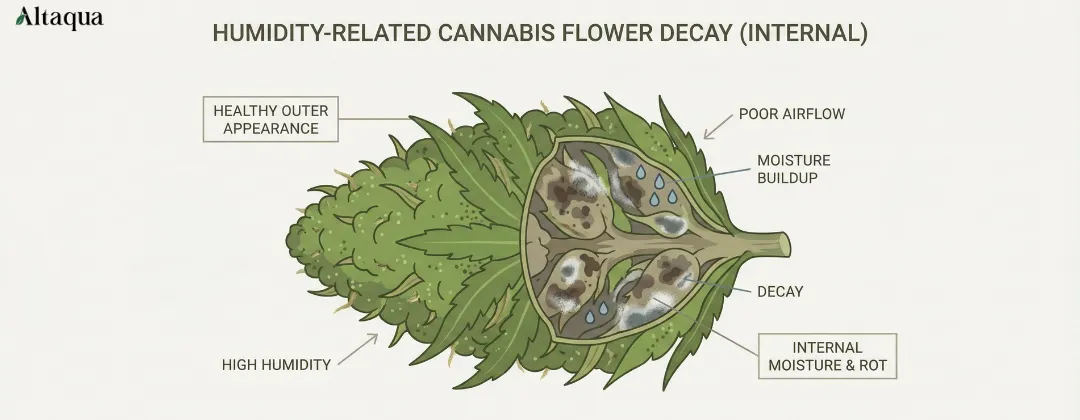
Bud rot refers to the internal decay of dense flower structures caused by excessive moisture and limited airflow. The outer surface may look normal at first, but inside, moisture becomes trapped, allowing fungal pathogens to develop.
Because the problem starts inside the flower, visual symptoms often appear late. By the time rot is detected, affected material usually has to be removed entirely to prevent further spread.
From an environmental perspective, bud rot thrives when:
- Humidity stays high for extended periods
- Air does not circulate evenly through the canopy
- Moisture is not removed efficiently from the room
- Temperature and humidity drift out of balance, especially at night
These are not planting issues. They are environmental control failures.
Why Bud Rot Happens in Grow Rooms
Indoor grow rooms operate under very different conditions than comfort-cooled spaces. Plants release large amounts of moisture into the air through transpiration, especially during late-stage growth. If that moisture is not removed consistently, relative humidity rises quickly.
Several system-level factors commonly contribute to bud rot:
1. Nighttime Humidity Spikes
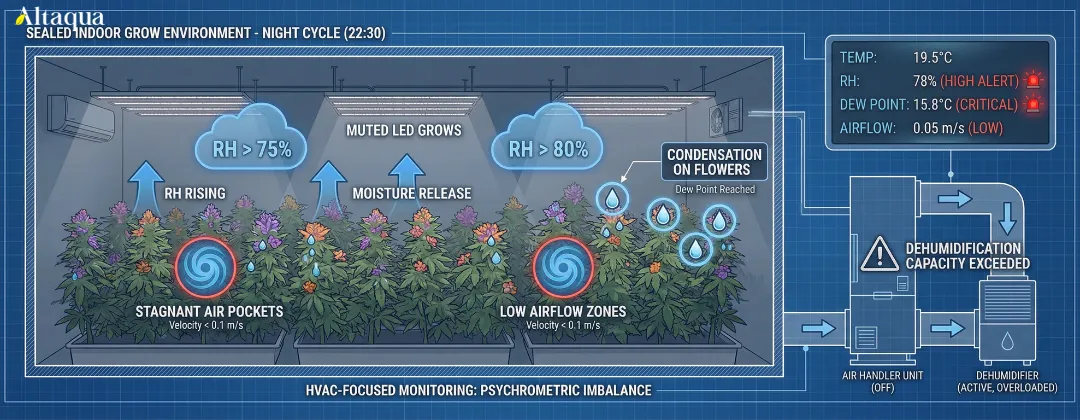
When lights turn off, temperatures drop. If moisture removal does not adjust accordingly, relative humidity can rise sharply. This is one of the most common periods for condensation and moisture buildup within dense flower structures.
2. Poor Air Distribution
Even if average room conditions look acceptable, stagnant air pockets can exist within the canopy. These microclimates trap moisture and reduce evaporation, creating ideal conditions for rot to form internally.
3. Dew Point Crossing
When surface temperatures fall below the air’s dew point, condensation forms. This invisible moisture accumulation inside flowers often goes unnoticed until damage appears.
4. HVAC Systems Focused on Temperature, Not Moisture
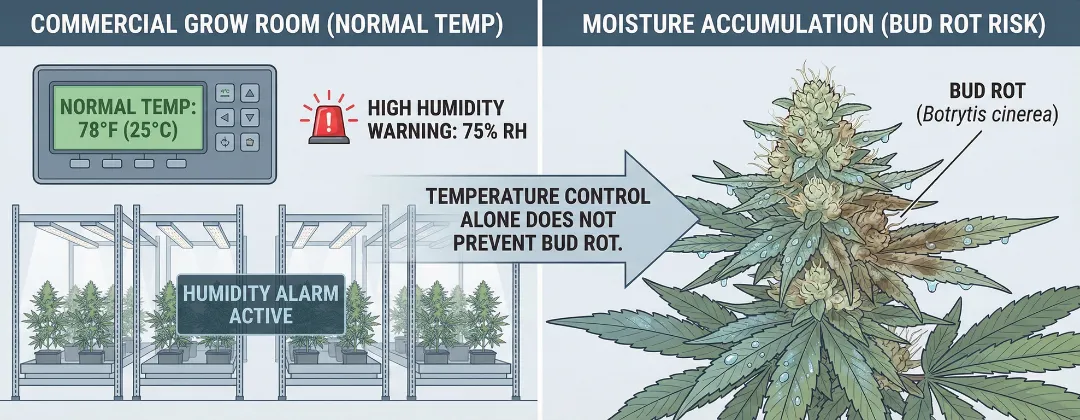
Standard air conditioning systems are designed to control temperature for human comfort. They are not engineered to handle the heavy latent moisture loads produced in grow rooms. As a result, temperature may appear stable while humidity quietly drifts out of control.
5. Inconsistent or Undersized Dehumidification
Portable dehumidifiers or mismatched systems may remove moisture locally, but they rarely provide uniform, room-wide humidity stability. Without coordinated control, moisture remains unevenly distributed.
Bud rot is not caused by a single factor. It is the result of unstable environmental conditions over time.
Why “Treatment” Doesn’t Solve Bud Rot Long-Term
Once bud rot develops, removing affected material may limit immediate spread. However, this does not address the underlying cause.
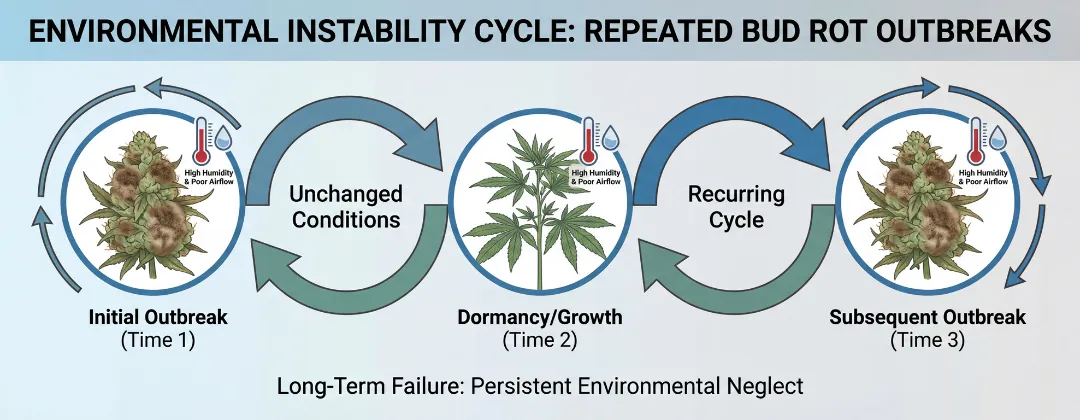
If humidity, airflow, and moisture removal remain inconsistent, the same conditions will continue to exist — and bud rot will return.
Reactive solutions focus on symptoms.
Preventive solutions focus on the system.
True prevention requires eliminating the environmental conditions that allow moisture to accumulate inside flowers in the first place.
How Proper Grow Room HVAC Design Reduces Bud Rot Risk
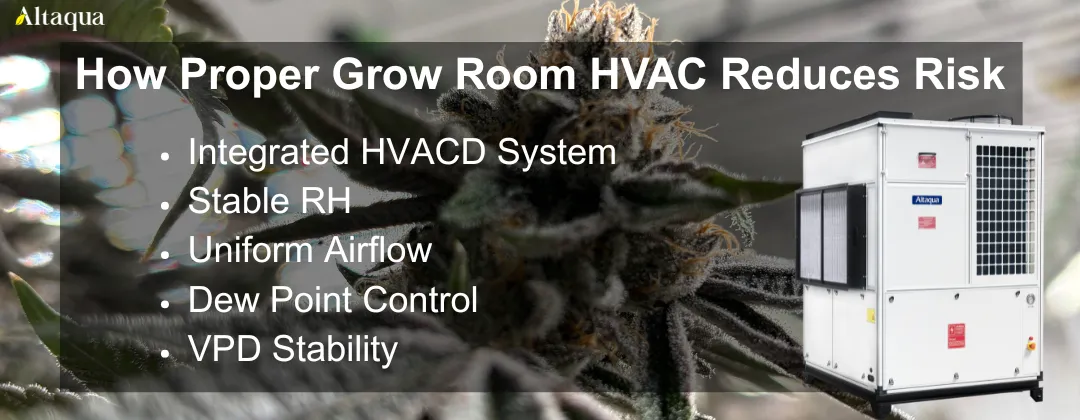
An effective grow room HVAC system is not just about cooling or heating the air. It is about maintaining stable, balanced environmental conditions 24/7.
Key design principles that reduce bud rot risk include:
Integrated Dehumidification
Moisture removal must be built into the HVAC system itself, not added as a separate afterthought. Integrated dehumidification allows humidity to be controlled as precisely as temperature.
Dew Point Control
Instead of reacting to RH spikes, advanced systems manage the relationship between temperature and moisture to prevent condensation from forming.
Balanced Airflow
Uniform air distribution ensures that no stagnant pockets develop within the canopy. Even airflow helps moisture evaporate consistently across the entire room.
Nighttime Humidity Stability
Humidity control must remain effective when lights turn off and temperatures change. Many outbreaks begin during this period due to inadequate moisture management.
Coordinated Control Logic
Temperature and humidity should not operate independently. When both are managed through a unified control system, environmental stability improves significantly.
The goal is not to fight bud rot after it appears —
the goal is to remove the conditions that allow it to exist.
Environmental Stability Matters More Than Exact Numbers
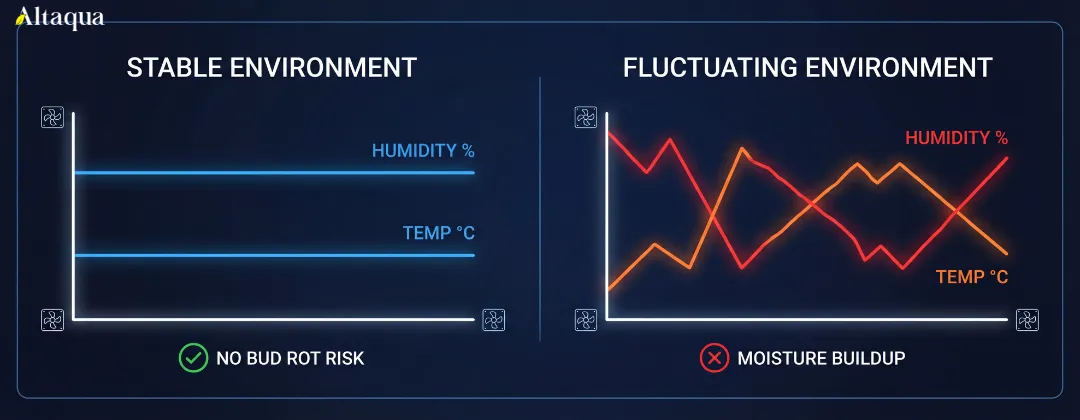
Growers often focus on hitting specific temperature or humidity targets. While setpoints matter, stability matters more.
Large swings in moisture levels, inconsistent airflow, and fluctuating dew point conditions create stress within the grow room environment. Even if average readings look acceptable, instability can still lead to moisture accumulation in critical areas.
A properly designed HVAC system prioritizes:
- Consistent humidity removal
- Stable temperature-humidity balance
- Even air circulation
- Continuous environmental monitoring
When the environment remains stable, the risk of bud rot drops dramatically.
Bud Rot Is a System Problem, Not a Plant Problem
Bud rot is rarely the result of a single mistake. It is usually the outcome of environmental conditions that were slowly drifting out of control long before visible symptoms appeared.
Treatments may manage damage.
Environmental control prevents it.
By focusing on proper HVAC design, moisture management, and airflow balance, grow rooms can significantly reduce the risk of bud rot — not through reaction, but through prevention.
In controlled environments, success is not defined by how problems are treated.
It is defined by how well they are prevented.

FAQ
1、What causes bud rot in grow rooms?
Bud rot is mainly caused by high humidity, poor airflow, and unstable environmental conditions. When moisture is not removed efficiently — especially during nighttime temperature drops — condensation can form inside dense flowers. HVAC systems designed for comfort cooling often fail to control moisture properly, allowing bud rot to develop.
2、Can standard air conditioning prevent bud rot?
No. Standard air conditioning systems focus on temperature control, not moisture management. Grow rooms produce heavy latent moisture loads that require integrated dehumidification and balanced airflow. Without proper humidity control, temperature alone cannot prevent bud rot.
3、How does grow room HVAC design reduce bud rot risk?
A properly engineered grow room HVAC system provides consistent humidity control, stable dew point management, and uniform airflow. By maintaining environmental stability 24/7 — including during lights-off periods — the system removes the conditions that allow moisture to build up inside flowers, significantly reducing the risk of bud rot.

Share with your friends:
Popular Blogs on Altaqua:



Download Catalogue